October 19, 2010

Denali V1.0 - Traveling to the Mountain

I have no more excuses.  This daunting task is now at hand.  To give myself the illusion that this is a manageable task, I've decided to break the trip into three sections:

1) V1.0 Traveling to the Mountain
2) V2.0 Getting to High Camp (14,200')
3) V3.0 12 Days at 14K

I make no promises, but I hope I get these all done before leaving for the Grand Canyon!

After making some final preparations in Boulder on May 19, we began our journey to the mountain by taking the bus to the Denver airport.  We arrived at the Anchorage airport at 1:30 am on May 20 and slept for a few hours next to a giant stuffed brown bear, presumably designed to deter tourists from wandering too far into the bush before they ever get a chance to leave the confines of the airport.  At 6:00 am we took a taxi to the Railroad Station in downtown Anchorage in order to meet up with a NOLS shuttle that was transporting a group of students from there to the NOLS branch in Palmer, AK, about two hours away.

It's always fun to visit new branch offices, and since neither Dane nor I had never been to Palmer, we took a branch tour before getting down to business.  The business we had planned was to procure the last of our needed supplies (free rental for instructors) and collect our rations for 23 days on the mountain.  We took some cooking gear and wands before bagging the food that we had predetermined, separated into three ration periods.  This all went pretty smoothly, and we managed to acquire all the food we would need for the trip for about $120 per person.

We had prearranged to meet a van from Denali Overland for a ride from Wasilla to Talkeetna, and we managed to finish up in Palmer in plenty of time to have the wonderful people at the branch drive us 20 miles in to Wasilla to meet up with this next leg of transportation.  In Wasilla we joined a group of four climbers from Seattle (Boeing employees) who were heading up on a private trip to climb the West Buttress route.  After about three hours in the van, we arrived in Talkeetna, the jumping off point for nearly all climbs in the Alaska Range.

Once in Talkeetna, we checked in with Talkeetna Air Taxi (TAT), which is a multi-functional company that caters to climbers while also running sight seeing flights for tourists.  TAT would eventually help us with in town logistics, supply us with a bunkhouse for the nights immediately before and after our stay on the mountain, as well as fly us to and from the Kahiltna International Airport on the Southeast Fork of the Kahiltna Glacier at the base of Denali.

Gearing up in Talkeetna
The flight to the glacier is notorious for stranding people in Talkeetna for several days before the weather is good enough to fly.  However, we had beautiful weather on our journey to Talkeetna and a terrific forecast for the next few days.  So, we spent that evening exploding and organizing gear for the glacier flight and bumped our mandatory meeting with the Park Rangers up to first thing in the morning.

When we felt sufficiently organized, we ate dinner at the Denali Brewery (average and overpriced), then bought a couple beers which we drank at the park while talking with a bad ass Polish guy who had just come off the mountain.  Once in Talkeetna, everything is within walking distance which made our brief stay there very convenient.

The next morning we met at 8:00 with a ranger for the national park service.  While we chatted with Ranger Kevin and watched a slideshow, a woman from the local radio station sat in on our conversation.  She was apparently working on a series of short radio programs to inform non-climbers of what goes on during the climbing season on Denali.  The report from our briefing is about 4 minutes long and can be heard here.  Immediately after the briefing, we went to the TAT office and got ready to fly out.

Our plane in Talkeetna, ready to fly to the glacier
Although you get on the plane in Talkeetna, you get off on a glacier at 7,000', so we flew wearing our climbing gear and ski boots.  Our official gear weight (which is taken seriously with these small planes) was 275 pounds, or just over 135 pounds per person.  We ended up flying in with the Boeing group and left Talkeetna around 10:30 am.  With beautiful, cloudless weather, views of the Alaska Range during the flight in were most spectacular.

The amazing Alaska Range
Vertical granite of the Ruth Gorge
Mt. Huntington
We landed on the glacier at 11:00 on May 21 in perfect weather, about 40 hours after leaving Colorado.  This rapid transportation time helped us make the most of our pre-trip acclimation by spending less than two days below 7,000'.

The plane and all our gear, landed on the Southeast Fork of the Kahiltna Glacier

October 13, 2010

Elk Huntin'

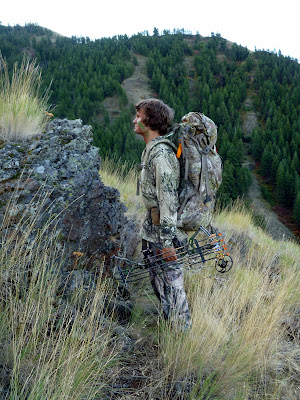
After my last NOLS course, I managed to catch the last 3.5 days of the month long archery season for elk in Oregon.  Jake already got his elk this year, so he was more than happy to take me into the Snake River Unit in the northeast corner of the state and show me the ropes.

Jake had been to this area once before while bear hunting.  He saw some elk on that trip and thought it might be a good place to go during elk season.  Turns out he was right.
Trying to blend in
After driving from Seattle, meeting up with Jake in Eugene, and driving to the remote corners of Oregon, past the town of Imnaha, we arrived at the spot where we would leave the truck.  Jake's plan was to backpack around, chasing elk, either until the end of the season or until I shot a bull.  We ended up being away from the truck that entire time, seeing bulls every day.

Jake and I have been accused of being the same person many times before.  With similar personalities and the exact same tuxedo measurements (with the exception of his neck being 1/4 inch bigger than mine), this perspective has merit.  However, hunting with Jake for these few days helped me realize that in some ways we are quite different and each have our own specialties.  Jake's happens to be elk hunting, and I was very impressed and honored to hunt with and learn from such an expert.  From his ability to spot the elk to knowing how they will react to everything we could possibly do, Jake must be part elk.

One of the many bulls we saw as seen through the spotting scope
After hiking in a few miles on the first day, Jake spotted a small herd of elk up on the ridge where we planned to go the next day.  Shortly after this, he spotted another elk skylined on the ridge as the sun was setting.  The silhouette of this large 350 bull was quite impressive, and from that point on I was super motivated to learn how to outsmart these magnificent creatures.  For this one, however, it was too late and too far away to hunt.

At the end of the following day, Jake spotted another small herd on a ridge about a mile away.  He put the spotting scope on them and told me to watch while he looked around for more.  Shortly after setting up behind the scope, I saw the tips of two antlers begin to rise over the ridge, following the small herd.  The antlers gradually got bigger and bigger.  I kept thinking that I would see fur any second, but the antlers just kept coming into view over the horizon of the ridge as the big bull slowly fed up the back side of the hill.  I think I was too excited to anything very coherent, but I remember saying something to Jake to the effect of "Jake.  There's a bull.  It's big."  When Jake looked over with his binoculars, he became even more enamored than I was.  He said the bull would have scored about 365-370, which would make it one of the largest elk in Oregon, much larger than anything Jake had ever killed in his 15 or so years of elk hunting.

When we saw the big bull, the sun was about a half hour from the horizon.  And we were about 2 miles from the elk via the path we would have to approach them.  Jake asked me what I wanted to do, but having no experience, I asked what he would do.  He said he would be very aggressive and run until he got about 300 yards from the elk, using terrain features to keep us out of view while we approached.  After that, he would continue at a slightly slower pace, getting as close to the animals as possible.  This is exactly what we did, and  just after sunset, we were within 100 to 150 yards of the herd.  A spike (young bull) was hanging near the herd, but not with it.  This presented problems as we had to try not to spook elk that were in multiple places.  We actually thought I might get a shot at the spike before nearing the rest of the herd, which I would have been happy to do as I was not trophy hunting.  We slowly poked our heads over the rise, thinking we would see the spike within range.  Turns out the spike had moved since we last saw it and was on the other side of the ridge top.  He moved into such an unfavorable position, he winded us and started acting weird.  When we saw him, he was 90 yards away, looking right at us.  We couldn't see the rest of the herd at this point, but it was clear that the rest of the herd was wondering why the spike was acting funny.  In attempt to get to the bottom of the young spike's odd behavior, the big bull came walking back towards us!  We were concealed by a small rock outcropping which also prevented us from seeing things very well.  Then Jake saw the massive antlers slowly begin to appear beyond the rock, about 50 yards from us.  The direction it was moving, it was about six steps from being broadside to us at 40 yards.  Jake told me to get ready to shoot.  At about that same time, the big bull winded us, smelling the same scent picked up by the spike, and promptly ran away.  So, at the end of the first full day of hunting, I was six steps and one good shot from killing the largest bull I had ever seen!  The kind of excitement involved was unlike anything I experience while climbing or skiing.

We didn't spot any bulls close enough to be worth chasing the next day, but on our third and final day we found the canyon where the majority of the elk were hanging out.  We heard a faint bugle, ran down into a canyon and up the other side to where we thought we heard it, heard it again yet another canyon over, ran down the next canyon and up the other side, seeing about 40 elk spread out all over the canyon, some as close as about 250 yards.  We couldn't try to move closer to any of them because one would inevitably see us.  So we just sat there and listened to them talk and interact.  Jake, being fluent in Elk, translated what they were saying.  For the rest of the day, we chased around various groups of elk, trying to get withing 30 yards of a bull.  With limited tree cover, closing the last 70 yards or so proved to be quite difficult.

Towards the end of the evening, we spotted a herd we chased earlier in the day about 800 yards away with a nice 325 bull in it.  Jake told me that I had learned enough by this point that there was no reason he should go with me.  Two people stalking a herd of elk just doubles the chance that one of them will see, hear, or smell you.  As soon as they all went over a small rise I began running at them, trying to make it to the spot where they disappeared before they had moved very far away.  I got to the rise and didn't see them.  They were feeding away from me the last time I saw them, so this wasn't very surprising.  I went to the next rise, and the next, all the while with very limited sight distance.  I started thinking to myself, "Where the hell are they?  They have to be right about here!"  Just after saying that to myself, I peered around the corner of a small cliff and say the bull about 80 yards from me, casually feeding away from my position.  Perfect!  The wind was blowing uphill, and the bull was across the hill, so he couldn't smell me.  After composing myself, I started to look around and assess the terrain features in order to figure out how I was going to get 50 yards closer.  As I peaked above the cliff I was standing under, I saw the cows!  The bitches had doubled back on me, completely changing directions.  They were now above me and it would only be a matter of seconds before they winded me and ran away.  Five seconds later, the entire herd was running up and over the next ridge, never to be seen again.  They disappeared over the last ridge in about a minute and a half.  It would have taken me a half hour to cover the same distance.

The hike back to the truck after that was not a sad one, and I felt no sense of failure.  I learned a lot about elk and now respect them even more, not to mention having a wonderful and exhilarating time chasing them around all day up and down the canyons.  The combination of skill and luck involved in a successful archery hunt makes it an addicting endeavor.  I can't wait for next September!

September 30, 2010

Backpacking, Canoeing, and Mountaineering

About a week ago I finished instructing another NOLS course.  This time it was the Mountain Section of a Pacific Northwest Semester.  We spent 10 days backpacking in the Pasayten Wilderness (Slate Peak to Hozomeen Campground at the north end of Ross Lake), 4 days canoeing on Ross Lake (Hozomeen Campground to Colonial Creek Campground on Diablo Lake), and 11 days mountaineering on Mt. Baker.  We had a group of 7 male students and 2 instructors (3 instructors for the first two parts).

I was fortunate enough to work with the famous Kenyan instructor, KG, who has something like 550 field weeks (that's over 10 years working in the field for those who are counting).  He was great to work with, and I learned a lot of important things, like how to deal with difficult students and when you go mountaineering, bring 3 pounds of bacon.

Deer next to one of our campgrounds on Ross Lake
A side trip up Devil's Creek
One of the highlights of the course for me was getting all the students to the top of Mt. Baker on the only sunny day of our stay on the mountain.  The glacier was in much better shape than the previous year when I ran a similar course, making navigation much simpler.  This whole NOLS thing still doesn't really feel like work to me.  I still find it extremely fun and rewarding!

Climbing the final steep section before gaining the summit plateau on Mt. Baker
Descending one of the only technical sections of the route

August 23, 2010

Climbing Road Trip – Part Final

Ava and I just finished up our summer climbing road trip. Since my last post, we spent a couple more days at Lovers Leap, finishing off pretty much all of the classics at and below the 5.8 level as well as The Line (5.9), a line so amazing it is called "The Line". Imagine a pill so amazing it is called, simply, "The Pill" . . . I digress. We also climbed for a day at Smith Rock on our way back to Seattle.

Anyway, I had been thinking about "The Line" and using it as motivation to climb and lead at a more difficult level for the last couple weeks of our trip. I chose this particular 5.9 because it has a reputation for being very protectable (easy to place gear anywhere on the way up to prevent a long fall) as well as having amazing and sustained climbing. The climb lived up to its reputation. In two long pitches, of sustained 5.7 to 5.9 climbing, we ascended the most striking vertical crack that splits the East Wall of Lovers Leap. I placed gear frequently but efficiently and managed to climb the whole thing cleanly, and most importantly, felt solid the whole way up. All the way up, the route demands a mixture of crack, face, and lie back techniques. It finishes with a 15-foot overhung section with great holds, many of them hidden.

After our last stint at Lovers Leap, we met up with Ava's dad in Truckee before heading north. We drove up to Smith, climbed hard for a few hours the next morning before it got too hot, hitting a few of the classic sport routes such as: Phone Call From Satan (5.9), 5-Gallon Buckets (5.8), Outlaw (5.9), and Light on the Path (5.10a). This was a great intro for Ava as she had never been to Smith Rock before, and it was fun to finish our almost entirely trad climbing trip with a little sport climbing. I was happy with how good I felt leading the harder climbs at Smith.

We stayed a night with Jake in Eugene before heading north to Seattle. The next morning I woke up early and made it to Conway, WA to begin briefing for my next NOLS course at 8:00 am. It's been a great road trip! I'd be more sad for it to end if I wasn't looking forward to the next month so much (teaching a mountaineering course, followed by archery hunting with Jake)! It's nice be back in the Northwest after being gone for almost 4.5 months.

August 15, 2010

Climbing Road Trip Part III – California

After getting stormed off of the Grand Teton, Ava and I were scheduled to meet up with Kris and Mel (friends from Seattle) in Yosemite for a week of climbing in Tuolumne Meadows. We drove to Truckee, CA and spent a day there with Ava's parents. As usual, it was great to see them and wonderful to have a real house to stay in for a couple nights. On our way down to Yosemite, we stopped and climbed at Lovers Leap, linking Surrealistic Pillar with Corrugation Corner for perhaps the best seven pitch 5.7 climb in existance. What made this even better was that Ava is leading trad climbs now and she was able to take some of the leads!

Corrugation Corner
We had dinner that night at the Strawberry Lodge, a place that is eerily reminiscent of The Shining before driving to Tuolumne Meadows. The next day we climbed Northwest Books on Lembert Dome while waiting for Kris and Mel to show up, which was a great introduction to Yosemite granite. The fun picked up dramatically upon their arrival.

The four of us had a great time camping, drinking beer, and climbing for seven days. Over that week, and in various combinations we climbed:
Bull Dozier (5.7), Dozier Dome;
Holdless Horrer (5.6), Dozier Dome;
Northwest Buttress (5.5), Tenaya Peak;
Great White Book (5.6R), Stately Pleasure Dome;
West Country (5.7), Stately Pleasure Dome;
West Ridge (5.6), Mt. Conness;
Haystack (5.8), Lovers Leap; and
spent a day toproping 5.7 to 5.11a climbs at Murphy Creek.

Kris, Mel, and Ava about half way up Tenaya Peak
All these climbs were of fantastic quality and constituted trip highlights. I was particularly fond of the climbs on Stately Pleasure Dome and the West Ridge of Mt. Conness, but I think I still like the climbing at Lovers Leap best of all.

There are so many "you had to be there" stories, I don't know where to begin and they wouldn't make any sense here anyway. I'll let the pictures do the talking.

The 4th pitch of West Country
Second Pitch of the Great White Book
West Ridge of Conness
Ava high up on Conness's West Ridge
We are currently taking the weekend off to avoid crowds, but plan to spend one more week in the Tahoe area before heading north so I can begin instructing a NOLS course out of Washington. For obvious reasons, I want this summer to continue indefinitely.

August 01, 2010

Climbing Road Trip Part II - Cirque of the Towers


After spending a month in Wyoming's Wind River Range, I apparently hadn't had enough.  Ava and I decided to begin the second part of our climbing road trip by heading into the Cirque of the Towers, which, as the name suggests, is an amazing cirque lined with granite towers on nearly all sides.  The abundance of clean alpine granite lines in this area is astounding.  This is located only a few miles south of where my course passed by just days earlier (we intentionally avoided the area due to its reputation for being crowded).

Before I begin to recount these adventures, please follow my logic: Cirque of the Towers - C of the Ts - Sea of the Tease.  Thank you.

We backpacked into the cirque on our first day with plans of achieving alpine glory on the subsequent two or three days.  The weather was questionable nearly the entire time, but we went for it anyway and were glad that we did.

Pingora on the right, with Wolf's Head just to the left and behind Pingora
On day two we got up early and hiked up towards Pingora Peak, aiming for the classic South Buttress line.  We ended up taking a non-standard approach to this climb that involved some interesting scrambling.  Sufficient wandering around on ledges eventually led us to the start of the climb, where we ran into two fellow NOLSies who were just starting the same climb.  I led the first pitch, which was an enjoyable 5.6 crack/corner system on surprisingly clean alpine granite.  Ava valiantly led the next 5.6 pitch which continued in a similar fashion.  We were then faced with the option of traversing to yet another 5.6 corner or continuing straight up a 5.8 crack system known as the "K" cracks.  The left side of the "K" cracks looked amazing, so I got my send on.  The first two pitches were great, and this one was notably better.  After that, a 300-foot scramble led us to Pingora's summit.

Leading up the first pitch of the South Buttress (look at those pretty new ropes!)
The "K" Crack Pitch
A Craig Weiland inspired summit shot on Pingora
While the climbing/scenery/summit/etc. were amazing, we both left wishing the route was at least twice as long.

Our camp with Pingora and Wolf's Head in the background
We awoke early again on Day 3 and marched back up the cirque in search of the East Ridge of Wolf's Head.  There wasn't much searching necessary, as we could see if from our camp, but getting to the base of the ridge proved interesting.  It was supposed to be a Class 3 scramble on grassy ledges.  We found the grassy ledges but still had to pull out the rope for a few moves down low and and two easy 5th class pitches up higher.  The fact that it sporadically rained on us while gaining the ridge didn't help.

Once on the ridge, the reason this climb is so famous slaps you in the face.  The first part of the east ridge varies from 1-foot to about 6-feet wide and is split by a crack that provides excellent protection as it ascends toward the jagged summit ridge.  Considering the shear drop off on both sides of the ridge makes its position splendid.  Despite the dramatic position, the climbing is relatively easy until the towers along the summit ridge are encountered, at which point the route finding and climbing difficulties increase.  The exposure below us was made more real when we were forced to traverse around some of the towers.

Feeling the exposure (notice the climbing shoe camouflage)
The blocky towers of the summit ridge
Ava traversing under one of the summit towers with lots of air below
Once we finally made it to the top, I felt more than usual the reality of only being half way there upon reaching the summit.  I believe the suspect weather contributed largely to this.  We still had to get down and the descent route would be off an entirely different side of the mountain.  The descent was adventurous, for sure, but we found the necessary rappel stations and safely made our way back to camp for what seemed like a longer day than it actually was.

We had optimistically hoped to climb the Northeast Face of Pingora on the following day, but due to several factors including: copious amounts of rain the night before, our bodies feeling the ware of the previous three days, sustained difficulty of the route, continuing questionable weather, and consideration of opportunity costs, we opted to hike out and head for the Tetons.  I hope to return to this amazing cirque many times in the future as the number of incredible alpine granite lines is practically limitless.

July 28, 2010

NOLS Backcountry Rock Climbing

I just finished my fourth course as an instructor for NOLS.  Along with 2 other instructors, we took 12 students rock climbing in the Southern Wind River Range of Wyoming for 4 weeks.  We finished with 11 students after removing a behavioral issue on day 12.  I took the problem student out after he verbally threatened a 17 year old girl.  We were deep in the mountains at that point, so the round trip hike to remove him was about 30 miles.  Was it worth it?  Hell yes!  The course dynamics improved tremendously after that and we all had a great time climbing backcountry alpine rock routes and ascending peaks.

The scenery kept changing but was always this beautiful.

This was the first course where I felt I had a solid grasp of the big picture and was able to comprehend the course progression while still being able to focus on the task at hand.  We had great weather and terrific amounts of mosquitoes.  Apparently I'm still not tired of the Winds because Ava and I are heading back there tomorrow. We plan to spend three days climbing in the Cirque of the Towers, which is the most popular and crowded area of the range - for good reason.  After that we'll head to the Tetons for a couple more alpine rock climbs before heading to Yosemite to meet up with Chris and Mel for yet some more climbing of rocks.

June 27, 2010

Climbing Road Trip - Part I

Ava and I just finished the first part of our summer road trip. The next phase will entail me teaching a Backcountry Rock Climbing Course in the Wyoming's Wind River Range while Ava heads to southern Colorado to work on a farm for a month. After that, we plan to resume our summer climbing road trip.

Phase I consisted of a day of climbing in the Flatirons of Boulder, Colorado, two days of climbing in Rocky Mountain National Park (RMNP), and two days of climbing at Wild Iris, about 30 minutes southwest of Lander, Wyoming. To kick things off, and since we didn't have a car as mine was still in the shop, we started with the Direct East Face of the First Flatiron. This is a 7 to 10 pitch classic moderate line in the Boulder area, with the added benefit of being able to walk to it from Keith's place in South Boulder. At a grade of 5.6, it wasn't particularly challenging but provided a great warm up since I hadn't climbed in a while. The weather was beautiful and we made it from house to house in just under 8 hours.

After getting Quatra back (that's what I'm calling my car these days), we made our way to RMNP to climb a couple of classic lines that I never managed to climb when I lived in Colorado. We got an early start on our first day and made our way from the Glacier Gorge Trailhead to the base of Sharkstooth. We spent the next several hours climbing the Northeast Ridge of Sharkstooth, a beautiful Grade II, 5.6 alpine rock climb. It was great fun, and in addition to being a wonderful climb in itself, also served as a great warm up for the following day's objective, the South Face of Petit Grepon.

Our first view of the Sharkstooth early on our first day

Looking up from the base of the climb

Ava climbing the ledge systems fit for marmots

The inset a couple pitches up the Northeast Ridge

Ava eating (typical) after climbing the Sharkstooth

We spent the night at Sky Lake, which is dramatically situated at the base of the climb we intended to do the next day.

The South Face of Le Petit Grepon (fun to say with an outrageous French accent) is a super classic (read "super crowded") climb on an intensely impressive feature.  At Grade III, 5.8, the climbing difficulty was pushing my mental and physical limits.  Knowing this in advance, we decided to begin the climb, and see how things went.  We could have easily bailed at pretty much any point if we decided we were in over our heads.

Petit Grepon from the base

The climb started out easy with two long 5.4 pitches, followed by a 5.7+ pitch which sets the tone for the rest of the climb.  Moving in to the awkward 5.7 portion of this pitch, I needed to remove my pack, which I clipped to a piece of gear and made Ava bring up when she followed.  Without the pack, I moved steadily to the next anchor.  Ava seemed to do just fine carrying both of our packs, so I "let" her continue doing this for the next few pitches.  The fourth pitch was the crux 5.8 pitch which had some steep, pumpy moves followed by about 8 feet of finger crack leading to easier ground.  I had to sit on a piece of gear just before reaching the finger crack, and in doing this noticed a fantastic foot hold that I hadn't seen before.  Using this helped me easily pass the section I had been struggling on, only to reach the dubious finger crack.  I moved quickly as my arms were already tired.  The fact that I was able to clip two stuck cams on my way up and avoid placing my own gear greatly increased my speed.  Before I knew it, I was through the crux and confident I could finish the climb.  The fifth pitch proved to be the most mentally demanding, primarily due to route finding difficulties.  Sufficient wandering eventually brought me to an adequate but less than ideal anchor.  At this point I was wishing the route was over, but the slightly easier and very fun and exposed climbing over the final two pitches left me wanting more when I reached the top.

Ava at one of our less ledgy belays

A party in front of us finishing the climb

Ava and me on top of Petit Grepon

We joined ropes with two other guys at the top to do a series of double rope rappels to reach the ground near our starting point.  Five rappels brought us to the ground, which we were quite happy to be standing on once again.  After breaking camp, we hiked back to the car, arriving shortly after dark.  This turned out to be the best two-day climbing trip I have ever been on!

We spent the next day driving to Lander, where we spent the night before driving to Wild Iris to sport climb for the next two days.  Wild Iris is a limestone crag in the foothills of the Rocky Mountains.  There are quite a few climbs here, but most are beyond either of our ability levels.  In two days we were able to climb most of the routes within our range.  Highlights included Ava leading a couple of 5.9's, which she had never done before, and I put up a 5.10a, which matches the hardest sport climbs I have ever led.

In 5 days of climbing, we managed to climb conglomerate (Flatirons), gneiss and granite (RMNP), and limestone (Wild Iris) in a Colorado/Wyoming tour.  I now feel good and ready to teach my backcountry rock course.

June 22, 2010

Denali Teaser


Dane and I have been off the mountain for almost three weeks now, and I've yet to find time to write and appropriately wordy post.  I'll be leaving on a NOLS course in a few days and I'm pretty sure I won't have time before then, so here's the super brief summary.

Dane and I both made it to the top, albeit on separate days.  We managed to climb our intended route, the Upper West Rib on our tenth day on the mountain.  We didn't ski off the summit, but we did do a lot of skiing above 14,000 feet, including skiing Rescue Gully from it's top at 17,200 feet.  We spent 16 days on the mountain all together and had amazingly beautiful weather pretty much the entire time.  We never had to endure a multi-day storm that Denali is so famous for, which made us feel like we missed out on part of the experience.  I promise a detailed trip account in the future.


Climbing the ridge from 16,200' to 17,200' on our way to ski Rescue Gully

Dane leading one of the neater sections of the Upper West Rib ~16,500'

May 16, 2010

Systems Check

With only a few days left before we leave for Denali, Dane and I thought it would be a good idea to do an overnight trip to check out the various systems we plan to bring on Denali (stoves, tent, camp shoes, clothing layers, etc.).  We chose to do this trip in the Indian Peaks Wilderness, an area where I have been many times, but entered from the west (something I've never done) with the ultimate destination of Lone Eagle Peak.

Lone Eagle Peak

The weather apparently did not understand what we were trying to accomplish as it snained (a combination of snow and rain) on us pretty much the whole time.  This warm and wet weather couldn't have been more opposite from what we expect to encounter on Denali.  Nonetheless, we had fun and accomplished what we wanted to.  The system I am most excited about: camp shoes/booties.  From inside to outside this system consists of: warm socks, down booties, 1/3 inch foam footbed, and overboots.  I think my feet will be warm and happy when I'm not in my ski boots.

Cherokee Peak

As for the trip itself, we hiked about 4 miles with skies on our backs due to lack of snow, then skied another 5ish miles before setting up camp near the base of Cherokee Peak.  The next day we hiked up a little further to the base of Lone Eagle Peak where we got some amazing views for a few minutes before the mountain disappeared in heavy snow.  The return trip to the car was uneventful and good practice for skiing with a heavy pack.

Dane crossing one of the several bridges on the way up the trail

I was super impressed with the ruggedness of the west side of the Indian Peaks Wilderness, which I found dramatically different than the east side.  The rock formations are reminiscent of those I've seen in the Winds and Tetons of Wyoming; rising abruptly and seeming to hover directly above you.